

Planet

Иконка
Сокращение цикла
создания с месяцев до 24 часов
Иконка
Полный контроль
над инфраструктурой и данными
Иконка
Неограниченное тиражирование
и масштабирование
Иконка
Независимость
и цифровой суверенитет
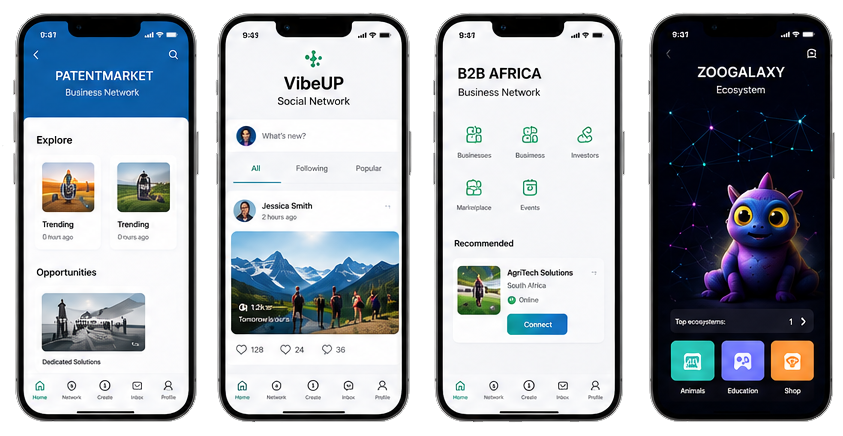
Иконка Более 100 нативных мобильных приложений и экосистем создано на основе технологии
Телефон 1 Телефон 2 Телефон 3 Телефон 4 Телефон 4

After the launch: which model for technology dissemination is more effective — open source or global partnership?
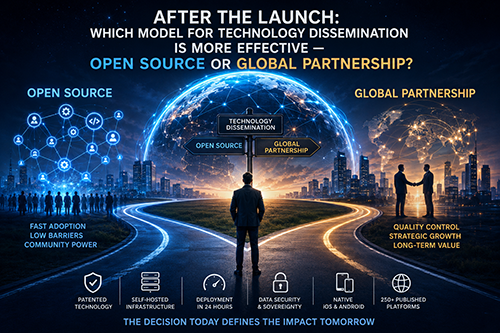
In engineering, it is commonly believed that the most challenging part of the work is creating a new technology. My own experience has led me to question this. Once a technology has been created, protected and validated in practice, a question arises that cannot be answered by engineering alone.

We have developed an engineering architecture that enables the deployment of independent native mobile platforms and digital ecosystems for Android and iOS directly on the customer’s server infrastructure within 24 hours. The development is protected by international patents, and an international PCT application is in place to ensure legal protection in various countries around the world. Its practical viability has been confirmed by more than 250 published social business platforms, social networks, digital ecosystems and mobile apps on Google Play and the App Store. Some projects »»

The result I obtained led me to a question that proved to be a complex one.

Once the fundamental engineering architecture has been created, validated in practice and protected by intellectual property rights, what is the most rational path for its further development?

I see two possible scenarios.

The first is to make the source code fully open and hand the technology over to the global professional community.

The second is to develop it through a single global partner or a network of independent regional partners, ensuring the implementation, support and further development of the technology in different countries.

Each of these approaches has compelling arguments in its favour.

Open Source is capable of ensuring the fastest possible adoption of an engineering solution and significantly lowering the barriers to its use.

The partnership model allows us to preserve the integrity of the architecture, maintain uniform engineering standards, attract long-term investment and scale the technology consistently.

Therefore, for me, the question is not about choosing between an ‘open’ and a ‘closed’ model.

The question is much broader.

Which model for disseminating fundamental engineering solutions creates the greatest value in the long term?

What makes modern technologies more quickly accessible to businesses, universities, government organizations and entrepreneurs?

Where does the line lie between the fastest possible dissemination of technology and responsibility for its further development?

It seems to me that the technology sector pays far less attention to this topic than it deserves. We discuss the development of new technologies, architectural approaches, artificial intelligence and software tools in great detail, but we talk far less often about how engineering solutions should scale once they have been introduced. Yet it is precisely at this stage that their real impact on the industry is determined.

That is why I place great importance on the views of those who create, fund and scale up technology companies.

Not because the technology itself needs to be discussed – the engineering aspect has already been proven in practice – but because its future development goes beyond the realm of engineering.

Perhaps the most important decision is made not at the moment the technology is created, but at the moment the model is chosen that will enable it to become part of the global technological infrastructure.

After the launch: which model for technology dissemination is more effective — open source or global partnership?

In engineering, it is commonly believed that the most challenging part of the work is creating a new technology. My own experience has led me to question this. Once a technology has been created, protected and validated in practice, a question arises that cannot be answered by engineering alone.

We have developed an engineering architecture that enables the deployment of independent native mobile platforms and digital ecosystems for Android and iOS directly on the customer’s server infrastructure within 24 hours. The development is protected by international patents, and an international PCT application is in place to ensure legal protection in various countries around the world. Its practical viability has been confirmed by more than 250 published social business platforms, social networks, digital ecosystems and mobile apps on Google Play and the App Store. Some projects »»

The result I obtained led me to a question that proved to be a complex one.

Once the fundamental engineering architecture has been created, validated in practice and protected by intellectual property rights, what is the most rational path for its further development?

I see two possible scenarios.

The first is to make the source code fully open and hand the technology over to the global professional community.

The second is to develop it through a single global partner or a network of independent regional partners, ensuring the implementation, support and further development of the technology in different countries.

Each of these approaches has compelling arguments in its favour.

Open Source is capable of ensuring the fastest possible adoption of an engineering solution and significantly lowering the barriers to its use.

The partnership model allows us to preserve the integrity of the architecture, maintain uniform engineering standards, attract long-term investment and scale the technology consistently.

Therefore, for me, the question is not about choosing between an ‘open’ and a ‘closed’ model.

The question is much broader.

Which model for disseminating fundamental engineering solutions creates the greatest value in the long term?

What makes modern technologies more quickly accessible to businesses, universities, government organizations and entrepreneurs?

Where does the line lie between the fastest possible dissemination of technology and responsibility for its further development?

It seems to me that the technology sector pays far less attention to this topic than it deserves. We discuss the development of new technologies, architectural approaches, artificial intelligence and software tools in great detail, but we talk far less often about how engineering solutions should scale once they have been introduced. Yet it is precisely at this stage that their real impact on the industry is determined.

That is why I place great importance on the views of those who create, fund and scale up technology companies.

Not because the technology itself needs to be discussed – the engineering aspect has already been proven in practice – but because its future development goes beyond the realm of engineering.

Perhaps the most important decision is made not at the moment the technology is created, but at the moment the model is chosen that will enable it to become part of the global technological infrastructure.